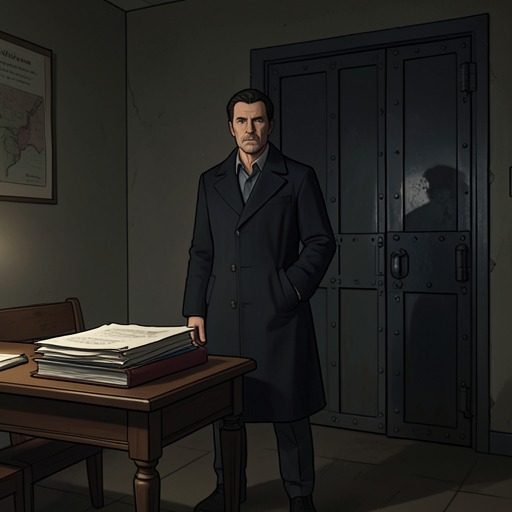
Newgate Prison
Great ExpectationsNewgate Prison is the novel’s principal London setting for the confinement and legal processing of people classified as criminals. It is at once a material institution—with rules, fetters, wards, and visiting yards—and a force that follows Pip beyond its walls: his developing fortune becomes inseparable from the convict system, and his visits make him conscious of the stigma he wishes to keep apart from his aspirations. Through the prison, the novel connects individual lives to a punitive legal order shaped by transportation, return from exile, evidence, and forfeiture.
Institution and Legal Work
Newgate enters Pip’s London life through Mr. Jaggers’s practice. At the lawyer’s office, Wemmick shows Pip casts of two notorious clients, one of them a murderer whose likeness had been made after his arrest. The casts turn criminal identity into a professional keepsake: evidence of the cases that brought the office credit, and an unsettling introduction to the people whose affairs underpin its work.
Wemmick then takes Pip to observe Mr. Jaggers in court. Jaggers questions a woman with such force that the magistrates and the people in the courtroom appear cowed; he demands that statements be recorded and presses both denials and admissions. Pip cannot easily determine which side Jaggers serves. The scene presents legal advocacy not as a simple alignment with either accused or court, but as the exercise of intimidating professional power within a system whose participants watch the lawyer closely.
The Prison and Its Inhabitants
When Wemmick brings Pip to Newgate, they pass a lodge where fetters hang among the prison rules before entering the jail. The visit takes place during visiting hours. A potman carries beer through the prison, while confined men speak with visitors from behind bars in the yards. Pip sees the institution as neglected and disorderly, a public space in which prisoners’ everyday contact with the outside world persists within the limits of confinement.
Wemmick moves among the prisoners with practiced familiarity. He recognizes individuals by name, stops to hear anxious clients one at a time, and is popular without inviting unrestricted closeness. His manner makes the prison seem to Pip like a garden under observation: Wemmick knows which people have appeared and seems to monitor their progress toward trial. Yet he also insists on the limits of his role when fees are insufficient, presenting himself as a subordinate rather than the principal. The visit thus shows both the personal familiarity through which legal business is conducted and the hierarchy that governs it.
From the Marshes to the Hulks
Newgate belongs to a wider geography of punishment that reaches from the countryside to the prison ships. In Pip’s childhood, an arrest party escorts two exhausted prisoners through darkness to a guarded hut and landing place. After an entry is made in a book, one prisoner is sent onward first; Pip’s convict is then taken by boat to a black prison ship moored offshore. The chained vessel seems to mirror the restraints of its prisoners, making transportation visible as a continuation of confinement beyond the mainland.
The convict recognizes Joe as the blacksmith whose pie he had eaten. Joe answers with compassion, saying that although they do not know what the man has done, they would not let him starve. The prisoner is rowed away among other convicts, and the torchlight disappears as he is taken aboard. This early episode establishes the personal and moral thread that later crosses Newgate: Pip’s relation to the penal system begins not in a London courtroom, but in an act of childhood charity on the marshes.
Pip’s Fortune and Criminal Stigma
The legal conditions attached to Pip’s expectations bind his private future to a concealed benefactor. Mr. Jaggers tells him that the benefactor’s identity is to remain secret, that the benefactor intends to disclose it personally, and that Pip must make no inquiry or even hint at a suspicion. The arrangement presents wealth as conditional on obedience to an unexplained restriction. When Magwitch later reveals himself, Pip understands that his expectations have come from a transported convict rather than the source he had imagined.
Magwitch explains that, after being told he would be discharged, he promised to find the boy who had fed him and kept his secret, and to give him two one-pound notes. He fulfilled that promise after their separation across different gangs and ships. Years later, having become a successful sheep-farmer and stock-breeder in New South Wales, he risks returning to England to see Pip. He knows that return is punishable by death, and insists that even a much greater danger would not have kept him from coming. Jaggers confirms that he had warned Magwitch that he was exiled for life and would commit a felony by returning. The prison system’s reach therefore extends across the empire: overseas labor and accumulated wealth do not erase the legal identity attached to transportation.
Prosecution, Forfeiture, and Pip’s Recognition
After Magwitch is captured, the case initially cannot proceed because the authorities need an officer from the prison ship to identify him. Although his identity is not in doubt to those who know him, the required witness is absent; Compeyson, who had intended to testify, is dead. Pip retains Mr. Jaggers, who admits nothing on the prisoner’s behalf. The episode makes legal procedure consequential in specific ways: identification must be established through testimony, and the absence of the designated witness delays commitment for trial.
Magwitch is eventually tried and sentenced to death alongside thirty-one other men and women. The court treats his return as an aggravated offense: he had repeatedly been punished, transported, escaped, and then come back to the country from which he was banished. The sentence, delivered in a crowded courtroom, makes punishment a public spectacle, while the judge’s account reduces Magwitch’s long life to a legal history of offenses and penalties. Magwitch accepts the sentence, acknowledging a judgment beyond the court as well as the court’s authority.
The same prosecution threatens Magwitch’s property. Information found among Compeyson’s papers points to money in a New South Wales bank and valuable land, assets matching the possessions Magwitch had listed for Mr. Jaggers as the inheritance he expected Pip to receive. Because Magwitch is an outlaw and had made no legally recognizable settlement in Pip’s favor before capture, Pip understands that he has no claim and resolves not to pursue one. He chooses to keep Magwitch unaware that the inheritance has been lost. Newgate’s significance thus extends beyond imprisonment: the legal consequences of conviction reach into property, anticipated inheritance, and Pip’s understanding of what he owes the man who made his fortune possible.
During the period before trial, Magwitch is too ill to remain in the common prison and is transferred to the infirmary, where Pip can visit him. The illness also means that he is not put in irons, despite being regarded as a determined prison-breaker. Pip sees him daily, though only briefly, and watches him grow weaker. These visits change the prison from an object of Pip’s earlier dread into the setting for an intimate obligation: he listens and reads to Magwitch, while the condemned man neither excuses his past nor asks Pip to reshape it. Newgate therefore gathers the novel’s opposing measures of judgment—legal status and personal conduct—without allowing either to cancel the other.